
2020 RCHS Transport History Book of the Year Awards
Judges’ report and announcement of winners
This year’s awards take place against a background of extraordinary circumstances. The coronavirus epidemic has forced the Society to cancel its usual awards presentation evening, which was scheduled for the end of April at Bradford. However, the awards themselves can still be made and perhaps, while ‘self-isolating’, more members will be encouraged to investigate some of the excellent short-listed titles discussed in this report, the cream of this year’s crop of transport history publications.
As long-standing members will know, the Society’s awards are made to the best new books in up to four categories and this year are chosen from those that received good reviews in our Journal issues of July and November 2019 and March 2020. This year we are making awards in four categories. Each winning author will receive a cheque and, when circumstances permit, a framed certificate. One of these category-winning books will then be named as the overall Book of the Year and its author will receive a further cash prize and, under normal circumstances, a silver cup to hold for one year. The prize money comes from a generous legacy left to the Society by the late David St John Thomas, author and publisher, which will enable us to continue these awards for the foreseeable future.
I would like to express my sincere thanks to those who work behind the scenes to make these awards possible – Matthew Searle and his team of book reviewers, whose informed assessments enable a draft shortlist to be drawn up for the judges. For those unfamiliar with the process, the book reviewers score each book against four defined criteria. In descending order of importance these are: their perceived contribution to transport history, the quality of research involved, their clarity and interest of writing and their presentation and usability. The weighted scores are the starting point for short-listing. The judges review the highest scoring books and settle on ideally three or four titles in each category for detailed consideration.
My thanks must also go to this year’s fellow judges, volunteers drawn from the Society’s membership, Roger Brice and Peter Filcek. Roger is heavily involved in administration of the Society and one of those principally responsible for ensuring it reaps the benefits of modern communications technology. Peter is a marine engineer by profession, with an interest in the history of transport and technology.
Following the judges’ remarks last year about the increasing proliferation of typographical mistakes in even the best produced books, it is pleasing to note an improvement in this year’s short-listed volumes, although it would probably be going too far to claim any responsibility for this development.
The judges short-listed eleven titles this year, including one two-volume work, drawn from exactly 100 books that were reviewed in the Journal, almost the same number as the previous year’s total of 99. As ever, new publications about railway-related subjects were plentiful and we selected five for consideration for Railway Book of the Year.
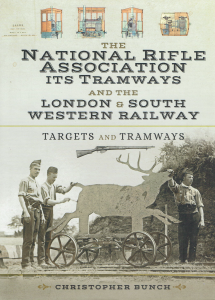
The National Rifle Association, its Tramways and the London & South Western Railway by Christopher Bunch, published by Pen & Sword Transport, price £40.
An original but perhaps surprising subject for a substantial transport history book, although a natural fit with this publisher’s other main field of interest, military history.
In 1859, in light of events in mainland Europe, Britain perceived itself to be threatened by the possibility of invasion. In response, the military authorities sanctioned the establishment of a Rifle Volunteer Force. The public reaction was enthusiastic such that by 1861 its numbers exceeded 170,000 men, of all social classes, in units across the country. In support and encouragement, the NRA was formed to arrange an annual rifle-shooting competition for enrolled volunteers. The initial venue was on Wimbledon Common, easily accessible from London via LSWR stations at Putney and Wimbledon. The railway companies were supportive, offering concessionary fares from all parts of the country to help volunteers attend.
As the range of rifles increased due to technical improvement, use of Wimbledon Common became problematic and in 1890 the Association moved to its present home at Bisley on the Surrey heathlands. Again, the LSWR was extremely supportive, anxious to retain the traffic, even to the extent of providing and working a short branch line from Brookwood into Bisley Camp. In addition to its branch line connection, the NRA had several internal tramways to transport competitors around the ranges and to provide moving shooting targets. These too are described and illustrated.
The author has mined the extensive archives of the NRA to provide not simply a history of the Association but a detailed account of its relationships with the LSWR, the military authorities, suppliers, contractors and other parties. Thanks to the survival of its letter books, he is able to tell much of the story in the words of those involved, using extensive verbatim transcripts. Although sometimes the other side of the correspondence has not survived, the NRA’s letters fortuitously began with a summary of the preceding, now missing, document. The author has achieved a level of detail and immediacy rarely achieved in archive-based research.
Although relations with the LSWR were not easy to begin with, with complaints about late running trains on the one side and misbehaving volunteers on the other, by the end of the 19th century the LSWR was sponsoring prizes at the annual event, overhauled the NRA’s Merryweather tram engine at Nine Elms Works and even had its own staff shooting clubs. This relationship continued into Southern Railway days through the personal encouragement of Herbert Walker, the SR’s general manager. The author does not explore the LSWR’s motivation in being so supportive, whether it was simple commercial self-interest, the result of personal interest shown by directors and senior managers or through some corporate sense of public duty.
The book is beautifully produced, heavily illustrated in black and white and colour, with maps, an index and short bibliography.
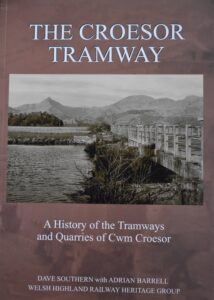
The Croesor Tramway, a History of the Tramways and Quarries of Cwm Croesor by Dave Southern with Adrian Barrell, published by the Welsh Highland Railway Heritage Group, price £18.
The Croesor Tramway was opened in 1864 to serve the slate quarries high up in Cwm Croesor. Previously, the only practical form of transport to export the slate was the packhorse. The tramway was constructed as a series of easily graded sections, always horse-worked, connected by gravity worked inclines. It was built privately by the principal landowner but was quickly subsumed into a statutory company. It suffered mixed fortunes, inextricably linked to the fortunes of the quarries it served, and passed through the hands of a number of other companies before eventually becoming part of the Welsh Highland Railway.
The book follows a thematic structure with chapters on the line’s history, a description of the route, brief histories of the various quarries served, some of the significant personalities involved and what remains to be seen today. Perhaps most valuable are those chapters describing operation of the tramway and the memories of local people who worked on or used the line. Appendices include extracts from Moses Kellow’s letter-book. Kellow was manager and part-owner of the Croesor quarry from the mid-1890s until closure and was an important innovator in the quarrying industry. One of his significant innovations was the introduction of hydro-electricity, to power quarry machinery and for haulage.
The book clearly draws on an extensive range of research. It is heavily illustrated in colour and black & white, the photographs well reproduced on the heavy, glossy paper. Two previously published maps by J.M. Lloyd are included but could usefully have been printed larger. An overall map and an introduction to the local geology would have been helpful for those unfamiliar with the area. The book’s reviewer pointed out that annual traffic statistics and accounts are available and would have added to the story. There are source references and a bibliography but no index.
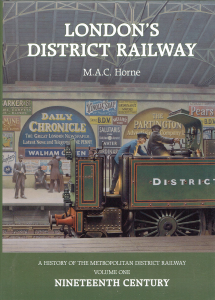
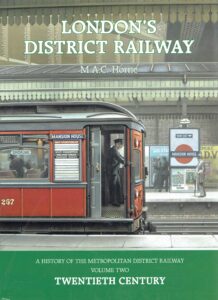
London’s District Railway, a History of the Metropolitan District Railway by M. A. C. Horne, published by Capital Transport Publishing. Volume One, Nineteenth Century £30, Volume Two, Twentieth Century, £35.
Compared with the Metropolitan Railway, the District has received relatively little attention from historians. But now, Michael Horne has given us a comprehensive history, running to more than 700 pages, that will surely become the definitive work on this railway.
The District was conceived to complement the Met by completing a circular route around central London, connecting the various southern main-line termini along the banks of the Thames to those served by the Met on the north side, a route now familiar to us as the Circle Line. By means of running powers over other companies’ lines it came to serve swathes of south-west and east London. It had a complicated and often unfortunate history and yet was of immense benefit to both local inhabitants and visitors to the capital. It was one of those railways, often teetering on the edge of bankruptcy, where the shareholders had to wait decades to see any return on their investment. Unable to raise further equity funds, the management had no alternative but to borrow, usually at expensive rates. The author judges that its management became ineffective and complacent. It took an injection of American energy, know-how and funding at the start of the 20th century to transform the railway into what was to become an important part of a co-ordinated transport system for London.
The author comments that the company’s minute books are not very informative so that the narrative had to be pieced together from a variety of other sources including deposited plans and Acts of Parliament, the contemporary engineering and business press, newspaper reports of shareholders’ meetings, Board of Trade inspection and accident reports, timetables and so on. It seems most unlikely that any significant information source has been overlooked.
The physical aspects of the railway are well covered, with drawings and/or photographs of virtually all the stations and detailed descriptions of subsequent infrastructure alterations. Locomotives, rolling stock, signalling, operational matters, staffing and many other aspects are considered. The author’s account of financial arrangements is particularly clear and understandable, as is the description of electrification and the construction of Lots Road power station.
These two handsome hardback volumes are heavily illustrated with numerous appendices, comprehensive source notes and a good index. It is difficult to find fault although the judges did find they needed recourse to maps from other sources to follow some aspects of the story.
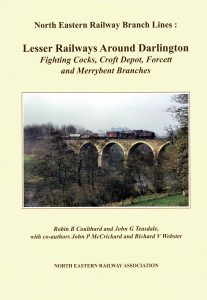
North Eastern Railway Branch Lines: Lesser Railways around Darlington by Robin B. Coulthard and John G. Teasdale with co-authors John P. McCrickard and Richard V. Webster, published by the North Eastern Railway Association, price £11.95
A slim history of four short railways around Darlington, all long since closed but not without interest. The first was initially part of the Stockton & Darlington Railway’s main line but was downgraded to freight use only when passenger traffic was diverted by the NER via Bank Top station. The second was a branch constructed by the S&DR. The remaining two were independently promoted branch lines built to exploit local limestone deposits, chiefly for use as flux in the many nearby blast furnaces, but also handling general freight such as coal and agricultural produce. One was worked by the NER from the outset although it remained a profitable independent company until 1923. The other worked independently to exchange sidings at the junction with the NER but was not a financial success and was absorbed by the NER in 1890.
Each line is accorded a brief history followed by a description of the route and its infrastructure, details of the various businesses served, traffic handled, operational arrangements and the eventual closure. The book is heavily illustrated with photographs and diagrams – remarkably so in view of the relative obscurity of the railways concerned. Source notes are included: the archives and members of the NERA have yielded much material, as have the National Archives and NRM.
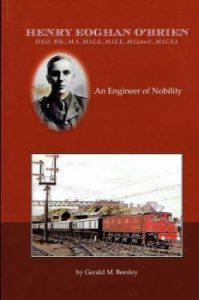
Henry Eoghan O’Brien, an Engineer of Nobility by Gerald M. Beesley, published by the author, price €22.50.
Henry O’Brien was born in Ireland in 1876, educated at Eton and in 1895 joined Kitsons of Leeds whilst continuing his education at the Yorkshire College (which in 1904 became Leeds University). In 1898 he became a pupil of John Aspinall on the Lancashire & Yorkshire Railway at Horwich, starting on the same day as Nigel Gresley. He rose quickly through the ranks and became an acknowledged expert on railway electrification. In 1903 he was appointed Resident Electrical Engineer for the Liverpool – Southport electrification scheme. By 1909 he was Assistant C & W Superintendent at Newton Heath, the following year Assistant CME at Horwich Works, now under George Hughes.
During WW1 O’Brien was seconded to the Royal Engineers, initially commanding a construction train helping to build the light railway network to supply the front lines in France and Belgium. His most important contribution to the war effort, however, was to manage the construction, equipment and commissioning of 12 national projectile factories to mass produce artillery shell cases. Later in the war he was in Palestine, providing supply lines to the forces fighting the Turks.
After the war he returned to the L&Y at Horwich. In 1922 the L&Y and the LNWR agreed to a merger in anticipation of the imminent Grouping. George Hughes was appointed Chief Mechanical & Electrical Engineer of the combined company with O’Brien as Electrical Engineer. He began to develop ideas for a main line electrification scheme from Crewe to Carlisle. Hughes and O’Brien were duly appointed to corresponding positions in the newly formed LMS. Precisely what happened next is unclear but presumably O’Brien’s ideas about electrification did not find favour with the Midland Railway dominated LMS Board and he resigned early in 1925, followed shortly afterwards by Hughes.
The author sets O’Brien’s career into its wider historical context and quotes extensively from the papers O’Brien read to his various professional institutions. He shows the importance of family connections in the building of his subject’s career. He has had access to family papers too, giving a vivid and well-rounded account of his life and work. The nobility of the sub-title refers to O’Brien’s claimed descent from Brian Boru, the High King of Ireland at the turn of the first millennium. The transport historian might find the extensive details of family genealogy of little interest. Readers with a technical background might be disappointed by the limited discussion of electrical engineering matters, although the technically illiterate may well be relieved. The photographs are small and not particularly well reproduced but the text is commendably free from typos. There is a 9-page index and a 5-page bibliography.
The judges were in agreement that the outstanding book and winner of the 2020 Railway Book of the Year award was London’s District Railway by M. A. C. Horne by virtue of its scholarship, depth of research and comprehensive coverage of all aspects of its subject.
This year two books were short-listed for the Canal and Waterways Book of the Year.
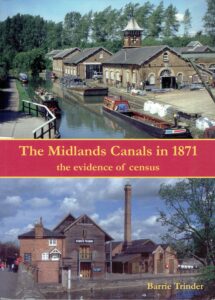
The Midlands Canals in 1871, the evidence of census by Barrie Trinder, published by Robert Boyd Publications, price £14.95.
During a period of ill-health, ‘almost house-bound’, the author undertook the prodigious feat of transcribing all the data from the 1871 census concerning people working on the canal system, for every parish through which a canal or waterway passed, covering the geographical area northwards from London, the Kennet & Avon and Somerset Coal Canals as far as Manchester, the Mersey and Humber estuaries. Treating each waterway in turn he gives a picture, taken on census night on 2nd April 1871, of how many people worked on the waterways, whether ashore or afloat, their professional roles and where occupied boats were located. Where boats were within customs ports such as Gloucester or Ellesmere Port, the enumerators issued special schedules which recorded vessels’ ports of origin, cargoes, the name of the master and the number of crewmen ashore, enabling an understanding of traffic flows.
By 1871 the railways had been making inroads into canal trade for some 20 years or more, while some canals were owned by railway companies. The author is able to demonstrate which waterways remained busy despite the competition and which were not. By examining comparative data from earlier and later censuses, he is able to show traffic trends. By analysis of the census data for those afloat he demonstrates that the characterisation of boat people by social reformers such as George Smith as incestuous, cohabiting and habitually drunken is almost certainly well wide of the mark, as was Tom Rolt’s more romantic 20th century perception.
The book includes clear and helpful maps and many modern colour photographs. While these do not particularly support the text, they do we think help the reader to work his or her way through the fairly dense factual matter by dividing it into manageable portions.
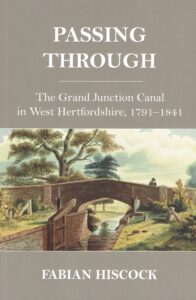
Passing Through, the Grand Junction Canal in West Hertfordshire, 1791-1841 by Fabian Hiscock, published by Hertfordshire Publications, price £16.99.
The author poses the question: what impact did the GJ Canal have on the area of Hertfordshire that 25 of its 92 miles passed through? No previously published histories of either the canal or the local region have attempted to answer this question. Did this mean that the canal had no economic or social impact, being primarily a trunk transport artery between London and the Midlands, or is the picture incomplete? To investigate, he restricts the study to the period up to 1841, by which time the London & Birmingham Railway was open and beginning to exert its own influence.
The opening chapter describes the economic and social scene nationally as it was in the 1790s. A north-south divide was beginning to open up in England, with mineral wealth, the beginnings of industrial development and urban migration in the north whereas the south, London excepted, remained largely rural, agricultural and self-sufficient. Agriculture was becoming more efficient through enclosure and improved farming techniques but this lessened the need for labour so that rural poverty was a problem.
The study then considers in detail the situation at that time in west Hertfordshire before comparing expectations with the reality of the canal’s arrival and how the various sectors of society were actually impacted. The canal was the first true external influence on the local economy given that the trunk roads to the north ran further to the east of the study area. Potentially the canal created new opportunities. How and why these were or were not exploited is examined and the study concludes with a review of how the area had changed by 1841.
The information for the study has been derived from sources that include the national census, trade directories, tithe maps and apportionments, turnpike trust and canal company records and the work of many previous historians. Although originating from an academic study, the writing is fluid, readable and commendably free of academic jargon. It is fully referenced and has maps, an index and extensive bibliography.
Both these books are meticulously executed academic works, each throwing new light onto their authors’ chosen fields of study. The Midlands Canals in 1871 is an exercise in quantification while Passing Through is a local history study. However, its findings may be more widely applicable to canals in rural areas generally. There is certainly scope for comparative work on other areas to be carried out. The judges’ decision was to award the prize to Passing Through, the Grand Junction Canal in West Hertfordshire.

Fabian Hiscock with his certificate for ‘Passing Through’
The third award this year is for Popular Transport Book of the Year. There were three books short-listed in this category.
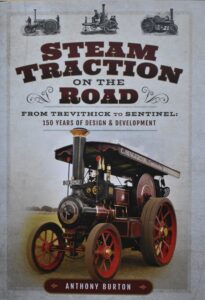
Steam Traction on the Road by Anthony Burton, published by Pen & Sword Transport, price £25.
This book fills a real gap in the market, with little published on the subject in the last 50 years. The author gives a chronological overview of the subject, beginning with Cugnot’s unsuccessful experimental vehicles of 1769-70, via William Murdock’s working model and Trevithick’s prototypes, which worked successfully but failed to attract commercial support. There followed a fascinating period in the 1820s and ‘30s when talented and innovative engineers including Walter Hancock and Goldsworthy Gurney produced steam carriages that operated successfully in public service for a while. It was unclear at the time whether the future of transport technology lay with steam propulsion on the road or railway. In retrospect we know the outcome, of course. The future for steam on the road lay in agricultural work and heavy haulage, with traction engines, steam rollers and fairground engines. Meanwhile, individuals continued to experiment with horseless carriages. Towards the end of the 19th century, steam powered cars featuring technical innovations such as the flash boiler and using oil rather than coal for fuel were produced commercially, both in the UK and USA, in competition with those powered by the internal combustion engine. In 1906 a Stanley steam car broke the land speed record at 127.7mph. One reason for their downfall was their cost. The final flourish of steam powered road vehicles was the steam lorry produced by firms such as Thorneycroft, Foden and Sentinel. These were ultimately displaced by diesel-engined vehicles, which required a single driver rather than a crew of two. Government legislation played a part too, when vehicle tax was made more proportional to weight. The very last new steam lorry left the Sentinel works in 1951, for export to Argentina.
The author provides a brief bibliography but sadly no source references. He appears to have used secondary sources throughout, including contemporary engineering journals, but has missed, for example, Prof. M.T. Evans’ important 1998 paper on steam carriages for the Newcomen Society, which gives a more nuanced explanation of why they ultimately failed. Again, readers with an engineering background might be disappointed by the level of technical discussion. As an overview of its subject, however, this book is very readable and has no competition.
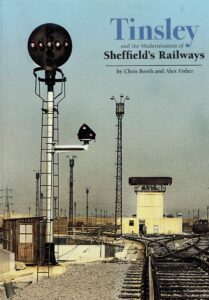
Tinsley and the Modernisation of Sheffield’s Railways by Chris Booth and Alex Fisher, published by Platform 5 Publishing, price £34.95.
The book begins with a brief history of Sheffield’s railways. The area was served by two competing companies, the Midland and what became the Great Central, resulting in duplicated facilities. This was perpetuated when in 1923 the MR became part of the LMS while the GCR fell into the LNER group. Other than some traffic pooling arrangements, there was little attempt to rationalise facilities. Following nationalisation, ex-LMS lines around Sheffield became part of the Eastern Region along with the former GCR lines but functional responsibilities were left as before. It was not until 1957-58 that territorial management areas were established and sensible rationalisation could begin. In 1959 the Sheffield area was responsible for 10% of BR’s freight and coal traffic. Freight traffic working, however, was described as ‘chaotic’ because of the large number of small freight yards which required extensive trip working, and the lack of interconnections between the former MR and GCR networks.
The solution was to create a single large marshalling yard at Tinsley, a single motive power depot at the same location and a single freight terminal at Grimesthorpe. New junctions were installed so that these facilities could be accessed from all existing routes. Lord Beeching officially opened Tinsley yard in 1965.
The book goes on to record the adjustments made in response to the rapid, often unanticipated, changes in the pattern of freight traffic. The decline of heavy industry began to reduce the volume of traffic almost as soon as the yard opened and the increase in block train working meant less need for remarshalling of wagons. BR’s eventual withdrawal from the wagon load market meant the yard no longer had much purpose.
The authors have drawn on BR files at TNA, NRM and Sheffield Archives, and used material from the Network Rail corporate archives. They have also been assisted by many people with personal knowledge and experience of the design, construction and operation of the yard, ranging from civil engineering staff involved in the design of the yard and its structures, to drivers, train preparers and telex clerks who operated the yard. The result is an extremely detailed account of every aspect of planning, design, construction and operation of this facility. Technical areas such as the design of the modular buildings, the Dowty wagon control system, signalling and operational information handling are not neglected. There is also much detail about the diesel depot, its locomotive allocation and several public open days held there.
A fine epitaph for a now obsolete feature of railway freight traffic and a microcosm of what happened to freight traffic on our railways in the second half of the 20th century, the volume is extensively illustrated in colour and monochrome, although some of the colour photos have not reproduced too clearly. There is a brief bibliography and index.
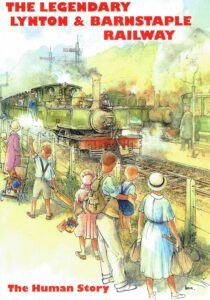
The Legendary Lynton & Barnstaple Railway, the Human Story by Tony Nicholson, published by the Lynton & Barnstaple Railway trust, price £9.95.
As the title indicates, the author sets out to tell the story of the L&B through the people connected with the railway, the human aspects of the story being sometimes neglected by more conventional railway company histories. He follows a chronological plan, beginning with some scene setting. The twin villages of Lynton and Lynmouth were quite isolated settlements before the railway was built. In 1854, when the railway first reached Barnstaple from Exeter, the coach journey on to Lynton took nearly three hours to cover the 18 miles. This remoteness was an attraction in itself to some. The wealthy publisher Sir George Newnes was one such, who discovered the delights of the place, bought land and built himself a house with a magnificent sea view. Having become part of the community, he clearly felt the need to use his wealth to promote improvements and, acting with other members of the local gentry, the L&B became one of the fruits of his altruism.
Opened in 1898, the railway reduced the time and cost of a trip to Barnstaple, and it brought more summer visitors. The locals were divided as to whether or not this was an ‘improvement’, and the author records the opinions on both sides. He has also found a number of affectionate accounts of trips on the line by holidaymakers. Incidents and practices which could only happen on a rural railway a long way from HQ are recorded too.
Sadly for lovers of the railway, after WW1 the much more convenient motor bus service began to take away the local traffic and the motor car began to nibble away at the summer tourist trade. The SR pulled the plug at the end of the 1935 summer season, the track was lifted and the assets sold.
Although the published version of the book does not include source references, the author is happy to make available an electronic file of the text with full annotation. This discloses the extent of his research into company minute books, local newspaper files, the contemporary railway press of the time and interviews with people who still have memories of the railway. He ends on an upbeat note with the story of the little boy who in 1935 won a competition prize – a family ticket for a trip on the line. Unfortunately, when the family arrived in Devon, the railway had already closed. Happily, 72 years later, the same gentleman arrived at Woody Bay and was finally able to claim his prize.
This is a well-produced, heavily illustrated and absorbing read, to sit alongside a more formal history of the company on the bookshelf.
The judges’ decision is to award the prize to Tinsley and the Modernisation of Sheffield’s Railways. It is unlikely that there will be a better book to explain the origins, construction, operation and demise of a major marshalling yard, once seen as the future of railway freight handling in the UK. This is an area which has received relatively little attention from historians up to now.
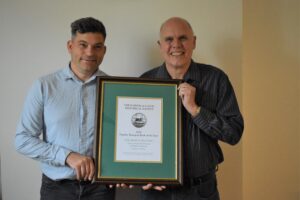
Chris Booth (R) and Alex Fisher (L) with their Book Awards certificate.
The final award this year is made to a rather unconventional publication to which the judges have decided to award a Special Prize.

The story of the rebuilding of the Upper Avon navigation by John Grundy, privately published by David & Alison Higgins
At the time of the awards this book was out of print. However, it has been reprinted and copies may now be ordered from the author using this order form: Upper Avon Story
Following the restoration of the Lower Avon river navigation from Tewkesbury to Evesham and the southern part of the Stratford Canal, the missing link in the waterways network was the Upper Avon navigation from Evesham to Stratford-upon-Avon. A Trust was formed, and David Hutchings, who had played a corresponding role in the Stratford Canal restoration was appointed Project Manager. With a staff of three (a crane driver, a welder and his secretary) he achieved the reopening of the navigation largely using voluntary labour, working parties from prisons and borstals and the army. Plant was donated or hired. The engineering was kept as simple as possible because of the use of unskilled labour. Nine new locks were built, each unique to suit the donated gates available and the local ground conditions. No attempt was made to restore what little remained of the original infrastructure. Weirs and water levels had to be rethought. A huge amount of dredging proved necessary and the disposal of the dredged material was one of the biggest and most expensive problems faced.
In addition to the engineering aspects, David Hutchings had to negotiate with landowners, the drainage authority and the various tiers of local government, overcoming concerns about new weirs and increased flood risk, invasion of private property by city-dwelling boaters and a myriad of other issues, not to mention fundraising.
John Grundy was a trainee design & technology teacher and due to the involvement of some relations in the project, was persuaded to write his university dissertation about the restoration. This lay in an attic for some 40 years until a chance conversation made David Higgins aware of its existence. David had already been concerned to create some sort of memorial to David Hutchings, who had died in 2005. He therefore had the dissertation and supporting documentation professionally scanned, printed and bound, with copies placed in appropriate archives and libraries as a resource for future historians and researchers.
After introductory chapters on the history of the navigation (already documented at the time of writing by Charles Hadfield and others) the bulk of the dissertation is a detailed chronological account of the work carried out and the day to day issues that had to be dealt with. After four years of planning and negotiation, work on the ground commenced in November 1968 and culminated with a formal reopening by HM the Queen Mother in 1974.
John Grundy was a diligent researcher. The supporting documents include his correspondence with those from whom he sought information – David Hutchings himself, Robert Aickman (who declined assistance because he was ‘already in touch with two people who say they are writing books about our project’), innumerable local government officials, river and drainage authorities, archives, newspaper and magazine editors, the list goes on. The number of replies he received offering no assistance or referring him elsewhere is testament to the author’s persistence. There are transcripts of previous legislation, going back to the order of 1635 allowing William Sandys to make the river passable, and a 19th century legal judgement about abandonment. There are many maps, plans and diagrams and photographs of work in progress and work completed, also an album of press cuttings.
This is not a conventional history book. One judge remarked that it looked like the contents of a filing cabinet but it is also a unique record of history as it was being made. Those two other books mentioned by Aickman never materialised and the judges felt that the combined efforts of John Grundy and Mr & Mrs Higgins to tell and publicise the story were deserving of recognition by the Society.
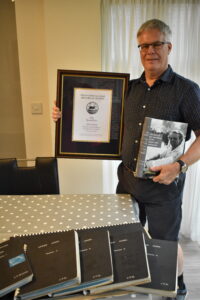
John Grundy displays his Book Awards certificate.
The multiple volumes of his original dissertation lie on the table.
At the time of the awards this book was out of print. However, it has been reprinted and copies may now be ordered from the author using this order form: Upper Avon Story. The cost is £45 plus £10 for post and packing. All enquiries should be addressed to the publisher, by email, at upperavonstory@gmail.com.
The judge’s final task was to decide the overall winner of the David St John Thomas silver cup and prize for 2020 Transport History Book of the Year. The judges had to compare the merits of the three category winners in dealing with their chosen subjects, bearing in mind the criteria of their contribution to our field of interest, depth of research, writing style and overall presentation.
Michael Horne’s London’s District Railway was our railway history book of the year. Despite its length it is consistently well written, thoroughly researched, covers all aspects of its subject in depth, is beautifully produced and tells a fascinating story.
Fabian Hiscock’s Passing Through is more modest in scope but equally well executed and presented, and pushes into territory that few other writers on canal history have explored.
The same might be said of Chris Booth’s and Alex Fisher’s work on Tinsley and the Modernisation of Sheffield’s Railways. Perhaps the authors have tried to include too much, maybe in an attempt to appeal to as wide a readership as possible, but the judges felt that this book contained new and important material that needed to be placed on record.
After careful consideration, the judges agreed that London’s District Railway was their Railway & Canal Historical Society Book of the Year.
|
Philip Brown, 2nd April 2020