
2019 RCHS Transport History Book of the Year Awards
Judges’ report and announcement of winners
The Society’s 2019 Transport History Book of the Year Awards were presented at the Abbey House Hotel, Furness Abbey on 26th April before an audience of over 80 members and guests.
Before getting down to detail, the judges wanted to make a general point about a problem that has become more commonplace in recent years. That is the increasing frequency of typographical mistakes being committed to print. They do appreciate that editing, layout and proof-reading are significant costs to publishers and whereas, in the past, several people would check the text and layout as they undertook their specific tasks, now everything is done digitally, often to tight deadlines, so that sometimes only one person checks the proofs before going to print. Hence mistakes have become more common. With greater importance now being attached to spelling and grammar in schools, this is unfortunate.
The judges short-listed ten books this year, drawn from the 99 titles that were reviewed in the Journal, a slight increase in number compared to the previous year’s total of 91. As ever, new publications about railway-related subjects were plentiful and four were selected for consideration. The first of these was:
Gilbert Szlumper and Leo Amery of the Southern Railway by John King, published by Pen & Sword Transport, priced at £25.
Leo Amery was a journalist, politician and director of many companies, including, from 1932, the Southern Railway. Gilbert Szlumper was a career railwayman, who rose to be General Manager of the Southern from 1937, in succession to Herbert Walker. Szlumper’s father had been Chief Engineer of the LSWR and subsequently the Southern.
Both Amery and Szlumper maintained diaries. Amery’s has been published in edited form and he also wrote an autobiography. However, mention of his railway work is disappointingly limited. Szlumper’s diaries commence in 1936 and are a much richer source for the historian, particularly those covering the war years.
In 1939 Szlumper was co-opted to work at the War Office as Director-General of Transportation & Movements. After the fall of France and the Dunkirk evacuation he was no longer needed by the military and was persuaded to transfer to the Ministry of Transport. Coming from a commercial background, he did not enjoy working with civil servants or politicians. There were further moves to the Board of Trade and then the Ministry of Supply. His desire to return to the SR was blocked and it seems he never understood exactly why. According to Amery, the SR Board had promoted Eustace Missenden in his place and promised Missenden that he would not be demoted should Szlumper return.
The author has intertwined the two diaries chronologically, often quoting verbatim but sometimes summarising and rewriting in narrative form to maintain the flow. Szlumper’s is full of detail about people and events. He also spent a lot of time committing his frustrations to paper, particularly at unhappy times during the war when he tried to return to the SR but was blocked for reasons he didn’t understand. The emollient and evasive responses from the Railway’s Chairman and his Deputy are frequently recorded. He also has much to say about the senior railwaymen from the other Big Four companies, who sat with Szlumper on the wartime Railway Executive Committee.
The value of the book lies in its portrayal of people and events in the top echelons of railway management, government and civil service. It puts flesh on the dry bones of more conventional transport history and is a fascinating illustration of how business was done at the time – and may still be done, if we did but know it.
The book is in Pen & Sword’s familiar house style with a good, clear font and relevant selection of illustrations. The impulse to include unnecessary pictures of trains has been resisted. The index mostly refers to people. References to events would have been helpful.
Scottish Railways 1923-2016 – a history by David Ross, published by Stenlake Publishing, priced at £40.
In the last few years David Ross has written an introductory volume to Scotland’s railway history, individual histories of the five principal Scottish pre-grouping railway companies and the present volume which continues the story from the Grouping, through nationalisation and privatisation to the present. Cynics might expect the result to be a bit of a pot-boiler, largely derived from secondary sources, but this is emphatically not the case. The book is lucidly written, well researched and comprehensively referenced. It is not a nuts-and-bolts account of physical changes to the railway, although much of this detail is included as appendices. Rather it draws out a number of themes, including the changing relationship between railways and government and the associated changes to control over the railways. With the Grouping in 1923, management of Scottish railways was transferred from Scotland to London and it remained there throughout the period, despite some more recent sharing of responsibility with the devolved Scottish government. In 1948 the Scottish Region of BR united the railways of Scotland for the first time and it showed a tendency to go its own way (ironically, not least when Englishmen were in charge). Under privatisation, the Scottish railways were let as a single franchise (apart from the sleeper services), reinforcing its distinct national identity. For example, unlike elsewhere, the Scottish saltire livery is retained despite changes of franchisee.
The effects of evolving political ideas and priorities, influenced by economic theorists and management consultants, is another key theme. The author mentions the impact of cost/benefit analysis leading to the change from straightforward profit and loss accounting to the concept of subsiding routes for wider social reasons. This was developed further into the theory of marginal social cost pricing, described in an appendix, applied to all forms of inland transport in EU States.
A further theme is labour relations. The author provocatively suggests that the Trades Unions have a better time of it under privatisation than under public ownership.
He acknowledges that a full, considered analysis of the last 30 years is not possible, in part due to the 30-year release rule for official documents, so this part of the book is by way of being an interim report. In compensation he has been able to interview some of the key personalities involved in these more recent events.
The book is well laid out and presented with a very clear typeface, good maps, a relevant selection of photographs, many of them unfamiliar, source references, bibliography and index.
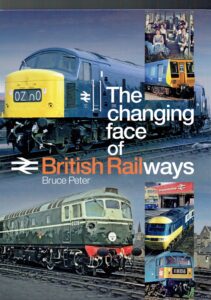
The Changing Face of British Railways by Bruce Peter, published by Lily Publications at £29.50.
There have been a few books published about British Railways design, all of which have focussed on the designers and their shiny ex-works products. This book takes a broader view, treating the railway not simply as a means of moving people from A to B but considering the total experience, from purchasing a ticket at the station, the station environment and catering offer, the exterior and interior design of the train, its cleanliness and condition, even the appearance, manners and attitude of the staff. It examines design from many perspectives – those of the managers who commissioned the work, the designers, engineers, architects and others who created the stations, trains and ships, the passengers (who were transmuted into customers and consumers during the period under review), even those like ourselves with an inexplicable affection for this form of public transport. It describes how the public face of British Railways and British Rail was achieved and perceived in the years since nationalisation. It manages to be comprehensive, brief and readable within its 336 pages.
A recurring theme of the book is that the high-minded intentions of the designers were not always realised. Sometimes the attitude of the engineers who had to convert their ideas into reality was unsympathetic or even antagonistic. On the other hand, sometimes the designers had no appreciation of the engineering constraints they had to work within. Beyond that, the long life of buildings and rolling stock compared to the more short-lived vagaries of taste and fashion, the innate conservatism of the general public, let alone the shortage of money and resources suffered at times by BR, the fraught industrial relations situation, particularly in the 1970s – all these conspired to produce a disconnect between the designers’ idealistic aims and the customers’ experience.
The author contrasts the pre-nationalisation situation, where the Chief Mechanical Engineers were powerful public figures, with more recent times where anonymity seems to be the rule. He places names on record – designers, engineers, architects, consultants and all – and has interviewed many of them. This is a history with people.
As befits a book on design, it is itself very well laid out, although, being of a certain age, at least one of the judges would have preferred a bolder typeface. It has a clear layout, makes good use of white space and has a good bibliography and index. The selection of photographs is excellent and relevant to the text, including a number of sequences showing the evolution of key designs.
A history of the Metropolitan Railway & Metro-land by Irene Hawkes, published by Crecy Publishing at £30.
The first half of the book gives a chronological account of the formation and development of the Metropolitan Railway, the world’s first underground urban railway, promoted as a solution to London’s traffic congestion. It goes on to recount the familiar story of Edward Watkin’s unrealised ambition to link the north of England with the continent via the various railways he controlled and a Channel tunnel. After Watkin’s death the Metropolitan’s ambitions reverted to the more modest aim of connecting the city to the suburbs. It was an early exponent of electrification, which was hugely beneficial.
The second half of the book concerns the Metropolitan’s activities as property developer. It was the only railway company permitted by its Act to grant building leases or sell ground rents. This enabled it to take an active part in the suburbanisation process and at the same time to grow its traffic. Interest in promoting housing development stirred early in the 20th century but the First World War delayed matters. After the war a separate company was incorporated to acquire freehold estates from the Railway. These were laid out and plots sold to individuals or builders. Quality of house design and good build quality were encouraged and very effective advertising put in place – ‘Metroland’ was created as an advertising slogan to sell a rural arcadia within easy reach of London. It was firmly targeted at the middle classes – very few working-class dwellings were provided.
The author examines the impact of economic factors: the initial labour shortages after the war, evolving government housing policy and subsidies, the effects of the General Strike of 1926, the 1929 stock market crash and economic depression of the early 1930s. She also examines the suburban way of life and the facilities and services available to residents. The availability of finance and how house purchase was made more affordable for those on lower incomes during the 1920s and 30s is another theme.
The book concludes with the redevelopment of the Chalk Hill Estate in the late 1960s, which was replaced by a much denser development which failed to live up to the planners’ expectations.
The history of the railway has been recounted elsewhere. The second half of the book is of much greater interest but it fails to bring the story up to date. There is a very extensive bibliography but it includes nothing published post-1983 except for a tail-piece of ‘Further Reading’ which lists a dozen or so more recent publications. Did the book have its origins in an academic dissertation written some time ago? The author is not at home with technical matters and perhaps here could have been better served by her publisher.
This was a very strong class but the judges were in agreement that the outstanding book and winner of the 2019 Railway Book of the Year award is The Changing Face of British Railways. The author, Bruce Peter, was present to receive his certificate and cheque from the RCHS President, Grahame Boyes.
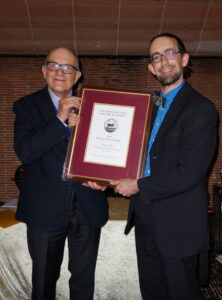
Once again, books on canals or waterways were scarce this year. Neither were there any outstanding books on tramways or road transport. Unusually, however, there were several important archaeological studies with a transport theme, so the judges took the decision to make the ‘Other Modes of Transport’ category into a Transport Archaeology class. Two books were short-listed.
An Immense & Exceedingly Commodious Goods Station by Rebecca Haslam and Guy Thompson, published by Pre-Construct Archaeology and priced at £30.
This is an extraordinarily detailed survey of a major London goods depot which combines archaeology, survey and recording of the surviving structures and its history from archive sources.
Being ‘information heavy’ it will never be a light read in any sense, but much thought has been given to presentation. Following an introduction which explains that the site was chosen by the GNR for its convenient access to the Regent’s Canal and local road network, chapters cover each period chronologically. These proceed from planning and construction in the years 1847-52, through the unprecedented traffic growth of the 19th century and the changes made to try to keep up with demand, the impact of two world wars and the difficult years between, then the mid 20th century period of declining traffic, nationalisation and eventual closure. The physical changes are set into local and national historical context and short vignettes on associated topics such as the formation of the GNR, Samuel Plimsoll’s improved, patented coal drops, use of hydraulic power, staff matters etc are inserted between chapters. Each chapter has a common structure: an introduction that sets the historical background followed by detailed descriptions of each landscape feature at the relevant period, integrating the archaeological, built heritage and historical evidence. Finally, a synopsis at the end of each chapter assesses the effectiveness of the changes recorded. Copious illustrations assist the reader’s understanding. Thus the reader can select a path through the book taking in more or less detail as he or she desires.
A comparison is attempted with two nearby rival goods facilities, at Camden and Somers Town, although neither has been the subject of such detailed examination and recording. Effort has also gone into understanding how the facility worked in terms of logistics and traffic flows, as well as the human (and equine) angles.
The integration of physical evidence with historical documentation is to be applauded. Some IA investigations have fallen into the trap of ignoring documentary evidence or the personal knowledge of those who worked at these sites in days gone by. Layout and design are exemplary with a clear font, bibliography and index.
Setting the Standard: research reports on the Willington Waggonway of 1785, the earliest standard gauge railway yet discovered, edited by Dominique Bell, published by Tyne & Wear Archives & Museums, £10
also The Wooden Rails that Blazed a Trail: Tyneside’s Willington Waggonway edited by Dominique Bell, Tyne & Wear Archives & Museums, £4.99
In 2013 during a pre-redevelopment survey on the site of the Neptune Shipyard on north Tyneside, a remarkable discovery was made. If anything, the archaeologists had been hoping to find Roman remains associated with the nearby fort of Segedunum. What they unearthed instead, in their final evaluation trench, was some rough, coursed masonry. Further investigation led to the discovery of substantial remains of an early wooden railway, subsequently identified as part of the Willington Waggonway. This had originally been constructed in 1785 to bring coal from Willington and Bigges Main Collieries to the Tyne for shipment. The discovery proved to be the most complete and best-preserved section of an early railway ever found. It was built to the ‘standard’ gauge of 4’ 8” and it included a ‘wash pond’ – a feature previously known only from the literature. Additionally, there was evidence that recycled ships’ timbers had been used in construction of the railway track.
The discovery is documented in two books. The first gives full details and analysis of the discovery, the second is aimed at the general reader, giving a summary of the findings in a heavily illustrated, 76-page booklet perhaps inspired by the well-known Shire Publications.
Following a scene-setting introduction and a summary of previous early railway finds in the north-east (mostly unpublished ‘grey literature’), the first volume includes a detailed description of the archaeology discovered during the excavation, concluding with a chronological reconstruction of events at the site as revealed by the archaeology. This is followed by a substantial historical essay which includes an account of sinking an 18th century pit based on the coal viewer William Gibson’s view book and diaries, held at the North of England Institute of Mining and Mechanical Engineers. The book concludes with reports on the conservation of recovered timbers, an investigation into the re-use of ships’ timbers and a geological investigation into the source of the stones used to construct the horse path through the wash pond.
As with the book on Kings Cross goods yard, history and archaeology have been brought together in a satisfying way. The concept of producing two publications aimed at different readerships is novel, and it will be interesting to see if others follow this lead.
The judges’ decision was to award the prize in this category to An Immense & Exceedingly Commodious Goods Station. Rebecca Haslam and Guy Thompson were presented with their certificate and cheques by Grahame Boyes.
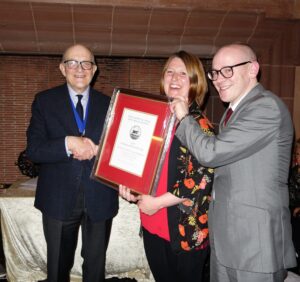
The third award was for Popular Transport Book of the Year. This year four books were short-listed in this category.
200 Years of the Lancaster Canal: an illustrated history by Gordon Biddle, Pen & Sword Transport, £25
Just in time for the 200th anniversary of its completion to Kendal, the Lancaster Canal finally has its history recorded in book form. The author has drawn on the canal company’s records held at The National Archives as well as material from more local archives. It is evident that he has also studied his subject extensively on the ground. The text is relatively brief but the book is heavily illustrated. There are some pictures from the days of commercial operation but the majority are the author’s own colour photographs taken over the last 50 years or so, which record much of the surviving infrastructure. The history continues into more recent times, recording the efforts made to retain the northern part of the waterway intact when the M6 motorway was constructed. To a degree these efforts failed in that, although culverts were provided under the motorway, they were too small to allow the passage of boats. Since then, some short sections of the canal have been returned to water and efforts continue to achieve more. Whether or not they will be successful remains to be seen.
The text is well written and interesting, but the book would have been improved with more detailed maps to illustrate more of the locations referred to in the text. Production values are to the publisher’s usual high standards. The author has deliberately refrained from the academic convention of annotations and footnotes but does include a bibliography and index
Cambridge Station: its development & operation as a rail centre by Rob Shorland-Ball, Pen & Sword Transport, £25
In twenty themed chapters plus prelude and postlude, which he likens to a prelude and fugue for organ, the author has composed a portrait of Cambridge station from inception to the present. As a student of geography, he explains the attraction of Cambridge as a target for railway promoters. Its location made it a focal point for traffic with, for example, coal from the Midlands and Yorkshire en route to London and the eastern counties while agricultural produce from East Anglia headed in the opposite directions. The story moves on to the history of the Eastern Counties Railway and its absorption into the GER, the arrival of other railway companies’ lines and how the station with its famous long, single-sided platform was operated. Track layout, signalling, goods and passenger traffic, motive power arrangements, private sidings all merit a chapter. The author recounts something of his own experiences working as a junior porter in the late 1950s and early 60s before reporting on the effects of the BR modernisation plan, Beeching Report and privatisation of the rail industry.
The author has unearthed various land and estate plans in the archives of Jesus College, which provided much of the land that the station was built upon. Otherwise his sources are mainly secondary. The writing style is conversational. Much care has been taken with the illustrations which are well integrated into the text although captions and acknowledgements have unusually been grouped at the end of the book. With its mixture of geography, history, explanation of railway operating procedures and reminiscence, concluding with extracts from the current franchisee’s publicity material, the judges were left not quite certain which audience the book is directed towards.
An Illustrated history of the Port of Hull and its Railways by Mike G Fell OBE, Irwell Press, £22.95
The author, who held senior posts at the Port of Hull from 1977-79 as a stevedoring operations manager and 1987-2003 as Port Manager/Director, modestly makes no claims to have produced the definitive history of the port and its railways but, rather, an informative and well-illustrated portrait. His sources include the press, the ICE and local archives, NER and LNER company publications and of course his personal experience from a privileged and well-informed internal position.
The result is an extremely readable account taking us from the earliest enclosed dock opened in 1778 by the Hull Dock Company, the first statutory dock company in Great Britain, through to the recent establishment of a major manufacturing facility for offshore wind turbines in the Alexandra Dock estate.
A prominent theme is the continual change in traffic handled, the result of circumstances beyond the Port’s control, and how the Port has managed to adapt and survive. The major growth in the 19th century was driven by coal exports and bunkering. That trade has long gone. The fishing industry too has come and gone. There was a 25-year period beginning in 1990 when coal imports for electricity generation were significant, now superseded by biomass imports for Drax Power Station. Containers and Ro-Ro vessels have replaced the traditional cargo ship with its requirement for skilled stevedores.
Another thread through the book concerns the people involved. The author has interesting things to say about labour relations, formal and informal, and the effects of the National Dock Labour Scheme. Introduced in 1947 with the laudable aim of improving conditions for dock workers, whose employment remained largely casual until 1967 (zero hours contracts are nothing new!), perversely it became an impediment to improving efficiency and the introduction of new traffics.
The port pre-dated the railway but it soon became the target of railway promoters. The first line, the Hull & Selby, opened in 1840, lagging a little behind the west coast ports of Liverpool and Bristol. The railway infrastructure grew to enormous proportions. It has since declined but still plays a role. All this is well illustrated with maps, plans and photographs, clearly reproduced with a good, readable type-face and unfussy design.
The First Railways – Atlas of Early Railways by Derek Hayes, published by Times Books, an imprint of Harper Collins, £30.
The sub-title is perhaps a little misleading. The book certainly contains many maps but first and foremost it is an overview of the early stages of railway development. Perhaps the publishers are trying to appeal to the same readership as their earlier successful book Mapping the Railways which won an RCHS Award in 2013. In short chapters it describes each important technical development and then the various railways that used that technology. It mentions briefly the earliest known systems for guiding wheeled vehicles, such as rutways and the ‘hunds’, running on planks and guided by a pin in a slot, used in central European mines, then takes us through the era of horse-drawn wagons running on wooden rails, the addition of iron strips to the top of wooden rails, then iron edge rails and plates and the introduction of steam locomotives. The focus is on developments in the UK. The author takes the story as far as the early years of the modern railway with the opening of the Liverpool & Manchester, London & Birmingham and Great Western. A short section on the transfer of technology to the USA and Europe concludes the book, with descriptions of some of the earliest overseas railways.
Production standards are high. The maps, of course, are the main illustrative material for this early period. Each railway described is thus documented, along with contemporary illustrations and photographs of surviving artifacts. In an attempt to include so much material, unfortunately some of the maps are reproduced to too small a scale for the reader to study the finer detail. The sources of the maps and other illustrations are recorded and there is an extensive bibliography, plus index.
The judges’ decision was to award the prize to An Illustrated history of the Port of Hull and its Railways. Mike Fell collected his certificate and cheque from Grahame Boyes.
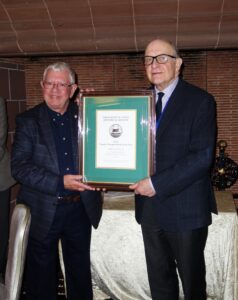
Finally, the judges had to decide the overall winner of the David St John Thomas silver cup and prize for 2019 Transport History Book of the Year. In making their decision they had to compare the merits of the three category winners in dealing with their chosen subjects, bearing in mind the criteria of their contribution to our field of interest, depth of research, writing style and overall presentation.
Bruce Peter’s The Changing Face of British Railways certainly breaks new ground for transport historians by presenting design as a cultural phenomenon, viewed from multiple perspectives. He also presents us with a review of the evolution of how design was thought about over the entire period of BR’s existence and over the whole range of its multifarious activities.
Rebecca Haslam & Guy Thompson’s An Immense & Exceedingly Commodious Goods Station likewise is innovatory in its integration of archaeology and history in a study of a goods station. Major passenger stations are in the public eye and have often been the subject of historical studies. Goods stations were off-limits to the public and much less well known or understood. It is a slightly daunting thought to learn that the monograph is but the first of three about this neighbourhood of London.
Finally, there is Mike Fell’s more modest but delightful Illustrated History of the Port of Hull and its Railways. A port by definition is a transhipment point between several different modes of transport. An account that looks at the changing relationships over time between the cargoes handled, the different transport modes, as well as the various methods of cargo handling employed, is therefore to be welcomed and hopefully emulated.
After due consideration, the judges agreed that The Changing Face of British Railways was their Book of the Year. Grahame Boyes presented Bruce Peter with the cup and a further cheque.

(Photos: Peter Filcek)